
I approached Michelle Tampakis, owner of Whipped Pastry Boutique, a local gluten free bakery. I asked her what problems she was facing as a small business owner that an e-learning course may help with. She mentioned that she spends lots of money on advertising materials and other customer outreach and she wished that her employees and herself had a basic understanding of graphic design so they could make some of these materials in house.

Goal: Participants will gain an understanding of basic graphic design principals to cut down on costs relating to customer outreach and advertising.
Process: With the desired learning outcomes in mind I set to consult with a subject matter expert and figure out the scaffolding required to instill these skills. I consulted with Andrew Drozd, a graphic design subject matter expert (SME), on what basic skills would have the most impact on a person with no graphic design background. I started an action map from our conversation on the program LucidChart. Mr. Drozd also pointed me to a text called “The Non-Designer’s Design Book” by Robin Williams which was an invaluable resource in putting this course together.

The action map highlighted the easy narrative path for chunking the information together. Each one of the four basic principles (Proximity, Alignment, Contrast, and Repetition), would make a manageable scene in the course. I color coded the action map to show which parts I was chunking together and began working on the narrative storyboard. This is one of my favorite parts of the Instructional Design process. I love being able to connect and order content, formative and summative assessments, and character interactions in a narrative arc.

When I storyboard, I make sure to include everything from dialogue, layer options, assessments, and visual assets. This level of planning ensures that when I begin to put together the interactive prototype itself in Articulate, it’s a matter of assembly. Once I plotted out the scenes, scripted the dialogue and planned out the assessments, I created a list of all the visual assets I needed and set to work on the design.
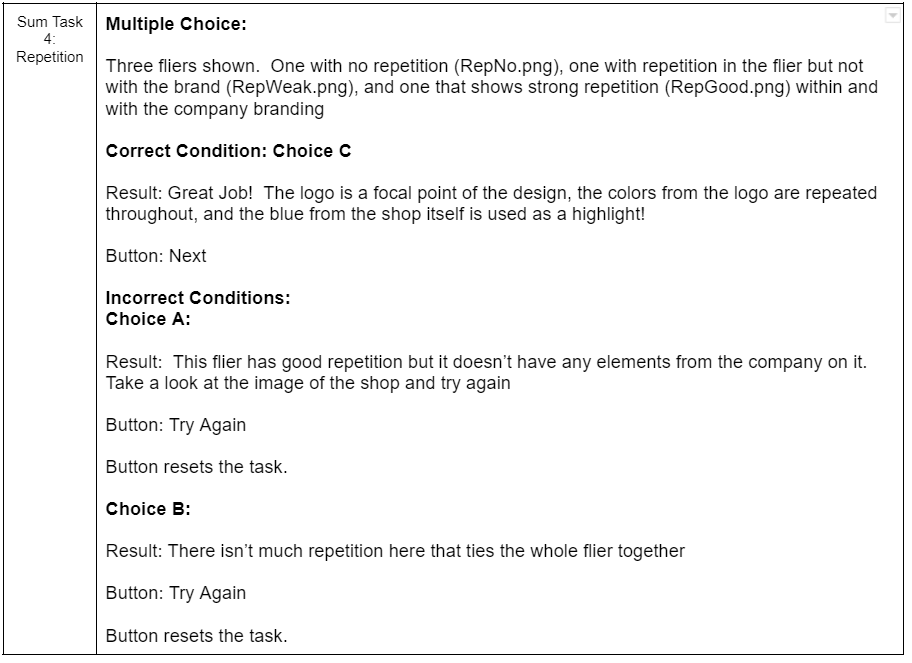
I chose to set the story in an ice cream shop called Chilly Valley Ice Cream. This is both a nod to a sweet shop like Whipped Pastry Boutique that my original customer owned, and a bright colorful location that felt eye-catching for participants. I worked with the color wheel to assemble a scene that really popped. For the assessment assets, I needed to craft exemplary answer choices and answer choices that did not fit the design principle in that chunk. For this I used a variety of tools from Adobe and Google Suites, and further consulted with my SME to make sure the materials I created fit the course.
Once I had a working prototype I elicited feedback from a variety of people including my SME, my initial stakeholder Michelle, and other instructional designers. I took the feedback and implemented it to create the current iteration.
Reflection: I’m really proud of how this course came out. Not only do I think the course is effective at reaching my stated goal, but I was also able to improve my own graphic design skills in the process. The book “The Non-Designer’s Design Book” gave me great ideas and insights that will improve my work going forward while also helping me with the design for this piece. While I did use stock assets from Articulate for the characters; the backgrounds, logos, and flier examples were designed by me using the Adobe suite of programs. I believe this course shows off my ability to structure and scaffold learning activities to effectively reach a larger goal. I also think this piece shows off my creativity and personality in the design and details of the work itself.

 Ryan Keough